Ramon Llull and his magnificent Tree of Science 

Ramon Llull

Ramon Llull, surely, is one of the most important minds in the history of Mallorca and may well be considered also to be one of the greatest thinkers of mediaeval life in all of Spain. He is considered the father of Catalan literature and also, one of the most universal European scholars of that time.

Ramon Llull2

Ramon Llull was born in 1232 in Palma de Mallorca. As a boy he served King Jaume I the Conqueror as his page and, when older, he acted as tutor to Prince Jaume, the future king of Mallorca. During his youth, Llull lived at court, serving as a butler and manservant while leading a cheerful and sometimes extravagant life. He was married and had two children.

ramon-llull-tree-philosophy-love

Following a number of apparitions at around the age of thirty, Llull gave up his bohemian lifestyle and adopted the Franciscan ideal, giving away his worldly possessions and becoming an itinerant preacher. Setting aside enough money for his abandoned wife and children, he renounced his immoral ways, working fervently to bring about the union of humanity with one universal religion and with comprehensive common interests. He wrote some 280 books of Scholastic Philosophy, on Science, Education, Mysticism and Grammar, as well as novels, which were translated into Arabic, Catalan and Latin. Today, Ramon Llull is seen as a forefather of the method of combinatorial thinking, the basis of modern computer software architecture.

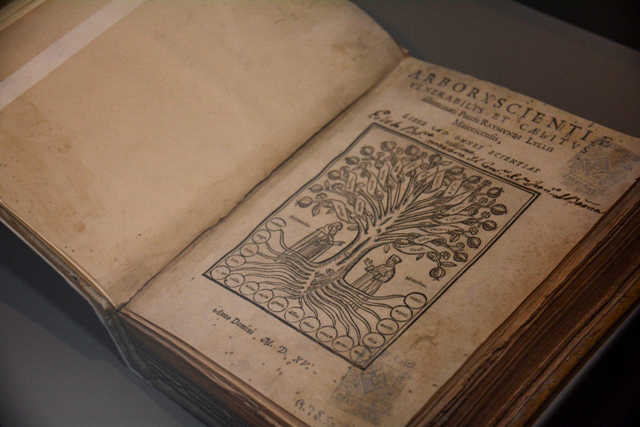
Ramon Llull Arbor Scientiae 3

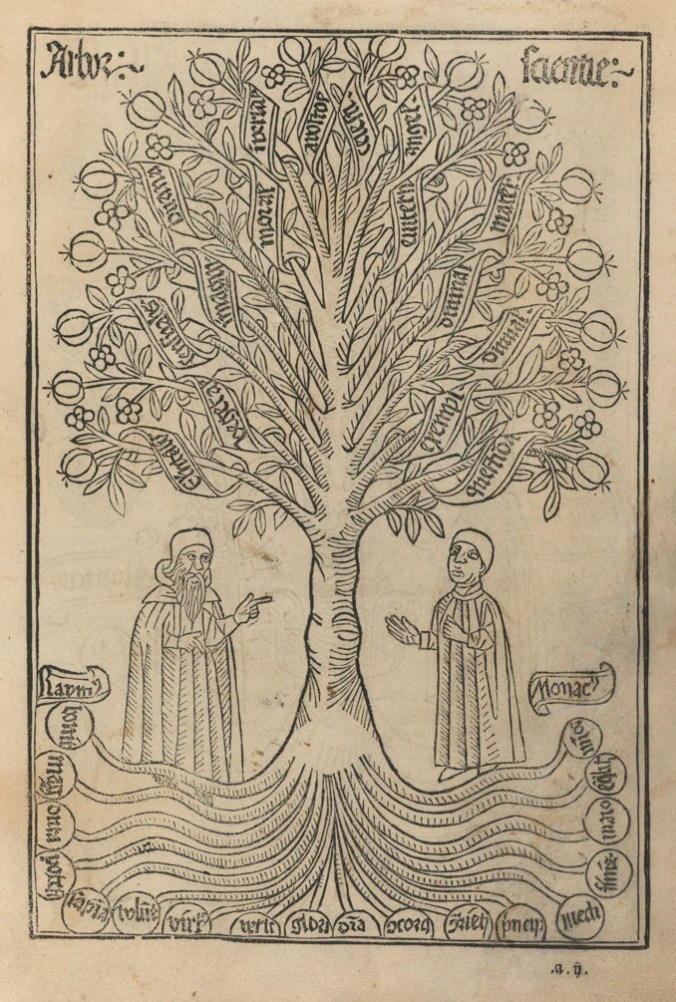
One of the most extensive and characteristic works of Ramon Llull’s is a book with the title Tree of Science (Arbor Scientiae). It is particularly interesting to us at Son Alegre with our holistic approach to organic agriculture. The book is a good example of Llull’s methodical and contemplative approach. Arbor Scientiae is structured according to a special arboreal symbolism by using the tree and its parts as a representation of human nature and relating them in a clear and understandable way with science. A tree and its roots, trunk, branches, leaves and fruit are taken as symbols of various disciplines of science. The roots represent the basic principles of every field of science; the trunk is the structure; the branches, the genres; the leaves, the species; and the fruit, the individual and their acts and finalities. This way, natural and moral philosophy converge. The objective of this encyclopaedic comparison served to enable the comprehension of universal knowledge, art and science.

Ramon Llull Arbor Scientiae 2

This book is considered the most beautiful and complete of the Llullian œuvre.

Ramon Llull Arbor Scientiae 5

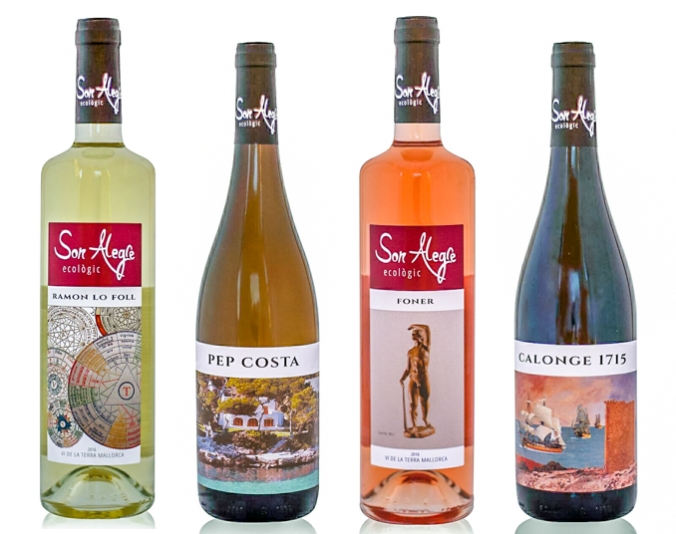
Vinya Son Alegre dedicate their 2016 white wine, with the colour of light, to Ramon Llull, who called himself Ramon the Fool but was also known as the Enlightened Doctor of Mallorca. On this wine’s label, we illustrate various samples of Llull’s Ars Magna discs of his combinatorial method.

Ramon lo Foll

¡Salut!
 

The Astounding Ways of Nature

Son Alegre granizada2

All winemaking, anywhere in the world, starts with agriculture, on the land, in the vineyard. All the components of growing wine are nature based – soil, climate, the vine plant, the nutrients in the ground nourishing this plant, water, mycorrhizae, insects, ants, worms, microorganisms, bacterial cells, and so forth. Each gram of soil in and around plant roots is inhabited by up to 10 billion bacterial cells. It makes you wonder how much – or how little – we actually know about our land, our soil and our role in agriculture and, as a consequence, about the true mechanisms of growing agricultural crops, or in our case, about cultivating wine.

Son Alegre granizada4

The key to agriculture and, by extension, the key to winemaking is a profound understanding of nature and its magical simplicity, combined with its infinite complexity. Us humans tend to think that we know it all and that we can control it all, can shape and master and manipulate nature and its mechanisms and can maximise the yield of our agricultural production. But little do we know, really.

Son Alegre granizada3

Our way of thinking about agriculture at Vineyard Son Alegre is marked by an organic and biodynamic approach. We believe that natural processes and interactions are not only necessary but are in fact indispensable in the growing of quality produce and food, or, in our case, quality grapes and outstanding wine. We believe it is best to leave nature undisturbed to the largest possible extent. That is why we have not ploughed our land for over ten years because we do not want to harm the microbiology of our soil. We do believe that a more diverse soil microbiome will in general result in fewer plant diseases, in a higher yield and in a better crop of fruit or wine. For us, an organic, ecologic, biologic and biodynamic approach to agriculture is the only conscientious way forward.

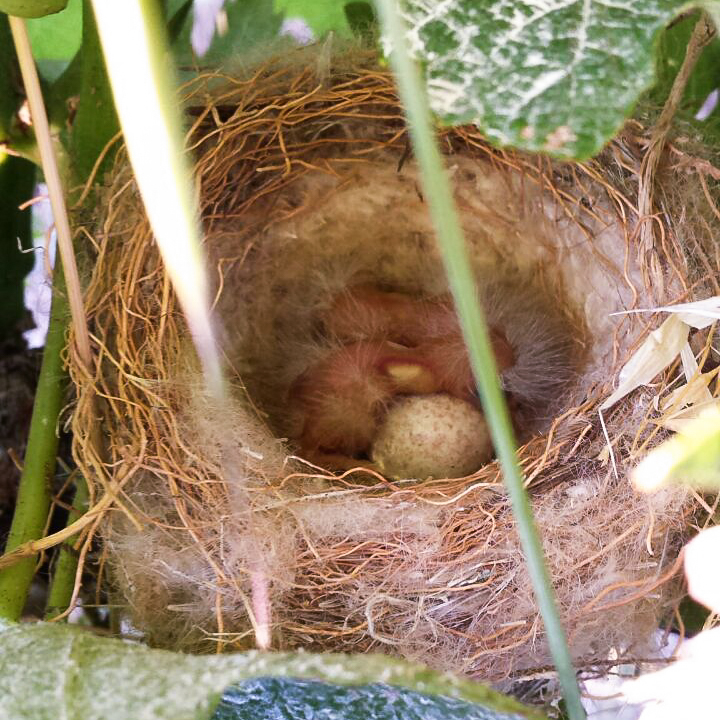
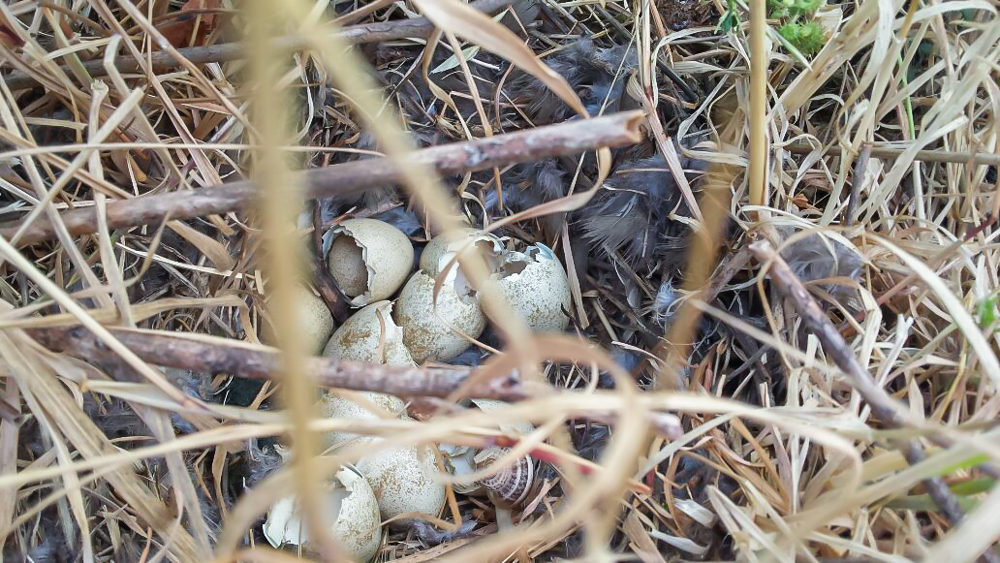
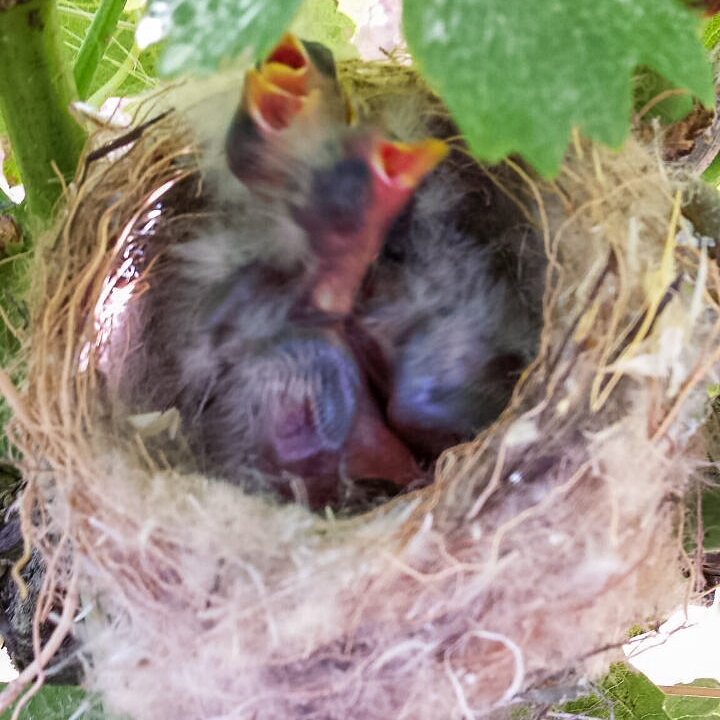
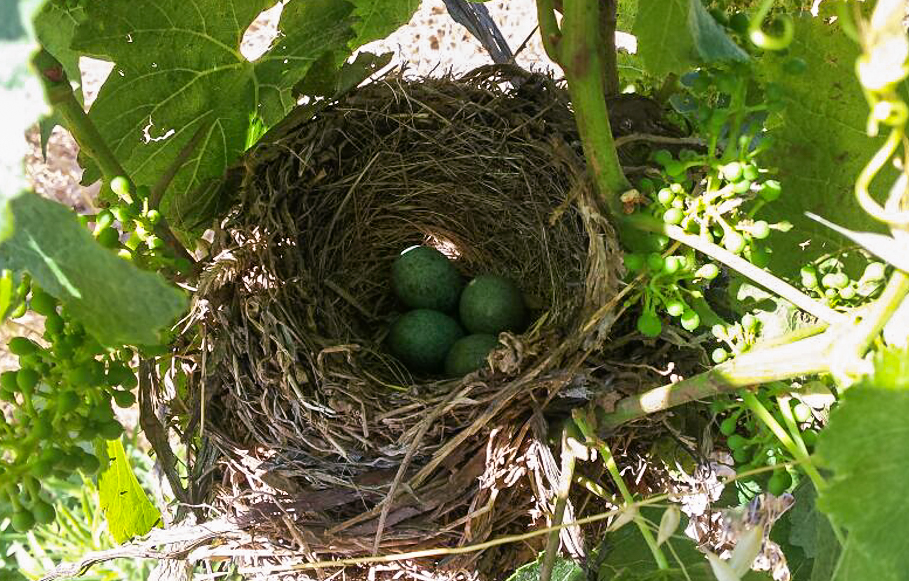
birds-nest 13

With this approach, we have been farming our land on the outskirts of Santanyí for the last 15 years or so, ever since we acquired this land. We thought we were doing things the right and balanced way, in harmony with nature and in congruity with the Universe. Our vines – and olive trees – prospered and grew over the years. Our extra virgin olive oil and our organic wines found acceptance in the market. From 8,000 bottles of wine (red, white and rosé) we gradually increased to 10, and 15, and even 20,000 bottles per year. This year we increased our output to almost 25,000 bottles. All was going well. Or so we thought.

Son Alegre granizada5

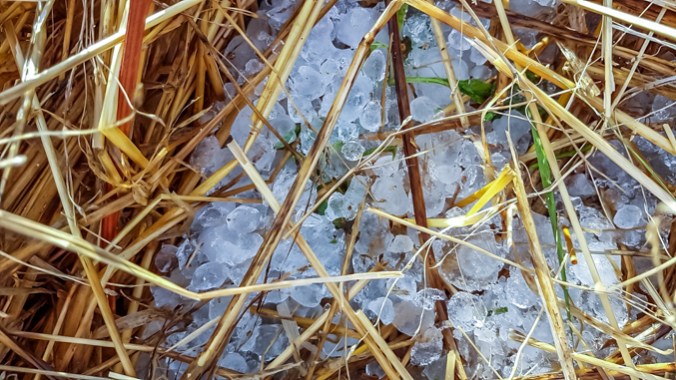
But BANG. On Saturday July 1st, 2017, Nature taught us a lesson and showed us that even a conscientious and biodynamic approach is no guarantee of success in agriculture. Our land suffered a downpour of 60-65 l of hail and ice over the course of 45 minutes at around midday, a hailstorm the likes of which had never been seen before in our area. In fact, nobody in Santanyí can remember such a wild and devastating storm of heavy hail, ever.

Son Alegre granizada7

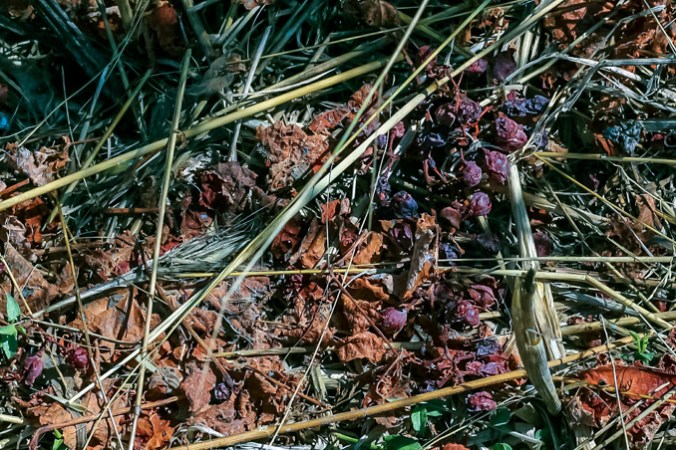
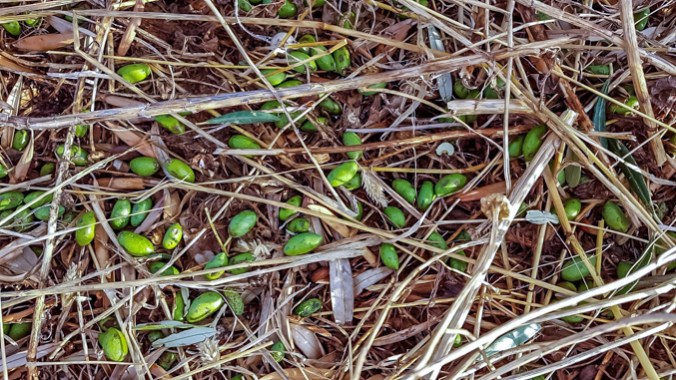
Our vines were almost completely destroyed and we lost an estimated 90 % of our crop of grapes. In the end, we managed to harvest barely 1,700 kg of grapes this year, compared with 22,000 kg last year. Our olives suffered a tremendous setback as well. We believe we have lost about 70 % of our olive crop and we are not sure that we will have more than 100 l of olive oil when the time for the olive harvest arrives at the end of October.

Son Alegre granizada6

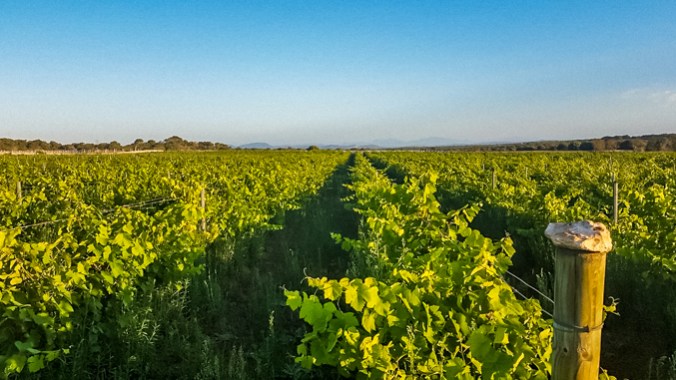
Surprisingly, and Nature often surprises us, our vines started sprouting new buds around ten days after the natural disaster and have developed a new and second growth of grapes since then. There may be a possible second harvest after all, albeit in late October, and weather permitting.

Son Alegre granizada8

The second growth grapes, if any are harvested, will not have been subjected to the normal conditions of our land and of our Mallorcan climate, with the heat of July and August and hot nights during the Summer, but will have grown under conditions similar to those on the French Atlantic coast. It will be interesting to see what the end-result of this act of capricious weather will be and what kind of wine, if any, might result from it.

Son Alegre granizada9

But that’s what nature is all about. Nature is always full of synergy and mystery, full of wonder and yes, amazement. The natural world surprises us in the good and in the bad. In the long run, it has proven again and again, that Nature is our friend. Even if this marvellous wonder of the natural forces can at times have painful consequences, we happily accept Nature’s wondrous ways. Ultimately, it is the best we can get.

If it is God’s will, a miracle will happen. If it does not happen, never mind. The lesson in humility is worth more than the fruit that the vineyard can possibly give us.

(Miquel Manresa Vadell)

Presenting Our New Organic Red Wine, Calonge 1715

Vinya Son Alegre 5

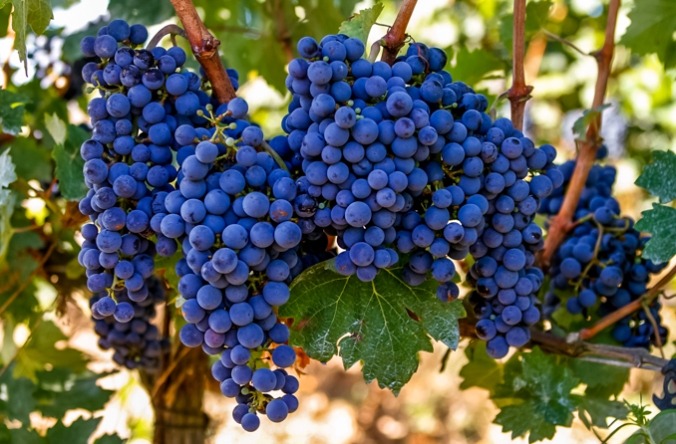
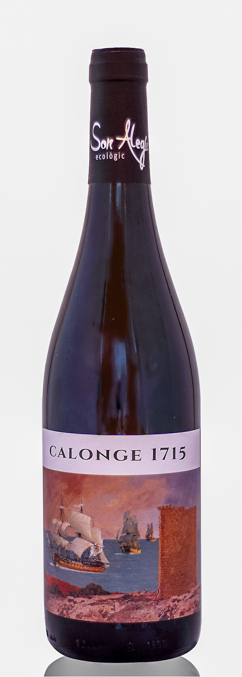
Vineyard Son Alegre dedicate their 2015 organic red wine to the honour and memory of those who fought for independence and freedom in 1715. This wine was composed with great dedication and effort from our Syrah, Merlot and Cabernet Sauvignon grapes. It is called Calonge 1715 to pay tribute to an important historic event.

Son Alegre Calonge 1715

Between June 15th and 16th, 1715, the village of Calonge, which in those days had no more than perhaps fifty inhabitants, lived through an important chapter of the final phase of the War of Succession.

The War of the Spanish Succession (1701-1715) pitted two European empires against each other and, with it, two dynasties with two differing models of government. The Austrian empire represented a diplomacy of treaties and a culture of comprehension, whilst the Bourbon empire symbolised Absolutism. The Kingdom of Mallorca, the Court of Valencia, the Principality of Catalonia and the Kingdom of Aragon all supported Charles III of Austria. But Valencia and Aragon had already fallen in 1707 and Barcelona in 1714, with only Mallorca and Ibiza remaining; Menorca had since 1708 already been under British rule.

Vinya Son Alegre 3

The Viceroy of Mallorca, who had assisted in the defence of Barcelona, ​​decided to resist the advances of the House of Bourbon and refused repeated requests of submission. An expedition of nearly 30,000 men of the Bourbon army set sail from Barcelona to Mallorca. They landed in Cala Llonga, Cala Ferrera and Cala Figuera during the afternoon of June 15th, 1715, carrying some 11,000 French soldiers, all well armed and trained. The next day, a militia of about 600 Felanitx residents fought back near Calonge. Thirty men lost their lives. The Bourbonic expedition continued to advance to Felanitx, Petra, Santa Margarita, Alcúdia, Sa Pobla, Binissalem and, finally, on July 11th, requested and was handed over the keys to Palma, the capital city. The Kingdom of Mallorca was henceforth subjected and subordinated to the Crown of Castile, their military commands and their language, who imposed their laws, taxes and even their language.

1716

However, over the past 300 years, the people of Mallorca have maintained the defence of their symbols and their own language. This wine stands as a guiding principle for independence and freedom.

All vines at Son Alegre in Santanyí are cultivated according to EU organic farming standards following quintessential biodynamic principles. Our vines were planted in 2004 and had an average age of eleven years when the grapes were lovingly harvested by hand in September 2015.

Fibonacci 16

The vinification of this wine occurred in stainless steel tanks under strictly controlled conditions of temperatures between 24º and 26º C during the fermentation process, followed by a maceration practice of 21 days. The ageing process involved thirteen months in stainless steel vats and twelve months in the bottle. The wine was bottled in October 2016. Only a total of 4,000 bottles were produced. That is not very much; we know. But we are only a small vineyard and our growth will always be as organic as are our agricultural endeavours.

Camp den Ventura-Vats

Our Son Alegre Calonge 1715 red wine has an alcohol content of 14.5% Vol. and is best served at between 15º to 18º C. Calonge 1715 is an honest Mallorcan red wine with a balanced nose and a satisfying finish in the mouth. This wine will age well over 6 to 8 years.

Calonge 1715

¡Salut!
Nature’s Secret Canon

Fibonacci 7

Nature is extraordinary, almost strangely funny in a way,  in as much as it is so simple in everything it does, whilst at the same time the environment, the earth and the whole universe are incredibly complex and complicated in their vastness and their seemingly endless, infinite expansion.

Fibonacci 2

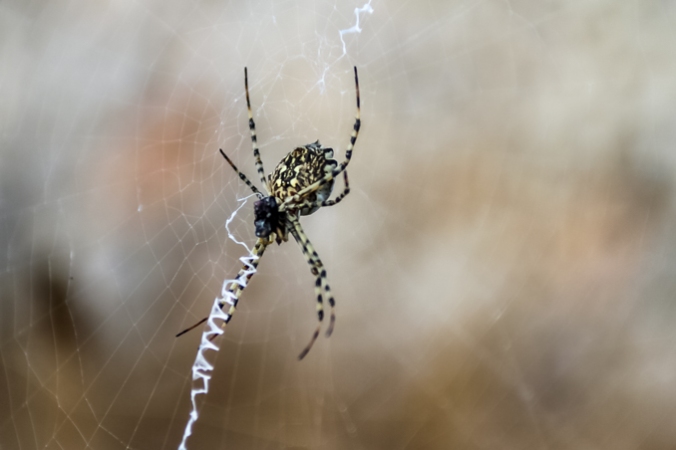
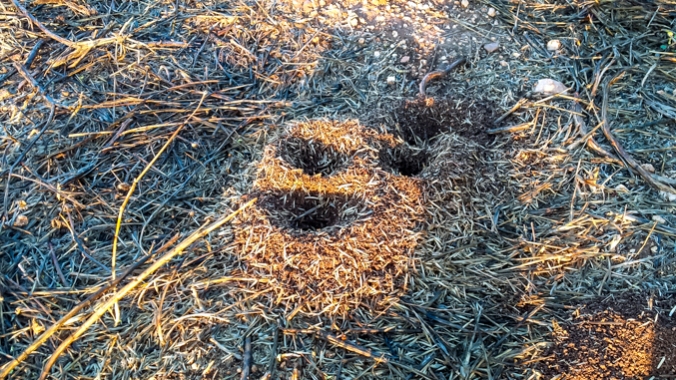
Spending a lot of time on the farmland, as we do on a daily basis at Son Alegre in our vineyard, and that includes Sundays as well as weekdays, we are in constant contact with the wonders of Nature and the natural world, the marvels of the elements, the wind, the weather, the effects of the sun, the moon, the stars and the planets. There is vibrant plant life and flora and there is boundless animal activity and inexhaustible fauna. There is a buzz all around us day-in and day-out, a constant movement of tiny creatures, ants, beetles, insects, worms, butterflies, bees, birds and wildlife such as rabbits, hedgehogs and rodents, and so on.

Fibonacci 8

Working on the land and in the vineyard gives one the opportunity to watch and to learn. One cannot but observe that Nature does not follow our human rhythm, our clock or our calendar. There is no twenty-four hour period in Nature. There is no seven day cycle. There is no Summertime and there is no holiday, festive or otherwise. Nature and plants, bees, ants and mycorrhizae are busy doing their job, only guided by daylight and the sun, the moon and the stars, being not much bothered by wind or rain, although occasionally interrupted by storms or hail, by torrents or flooding.

Fibonacci 11

Nature does not take a day off on Sundays, for example, and ants, worms and butterflies do not get an eight hour day, or sick leave or vacation, ever. They are all on the job continuously, day after day, from morning to night, and then again the following day. Our sheep demand their feed, as do our pigs, be that workdays or Sundays; they would more than just wonder if they did not get their food or water at the appointed hour.

Fibonacci 10

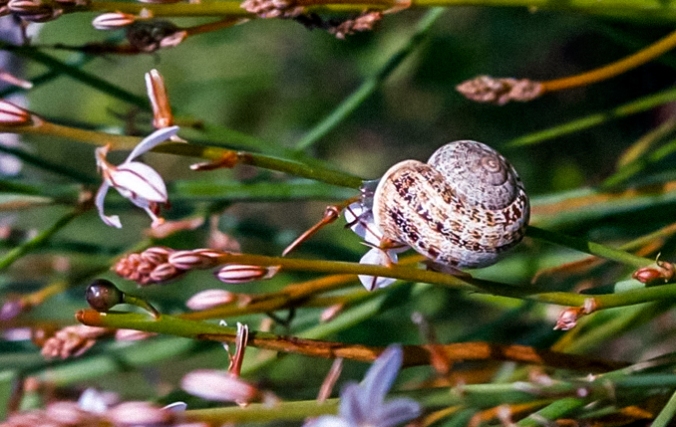
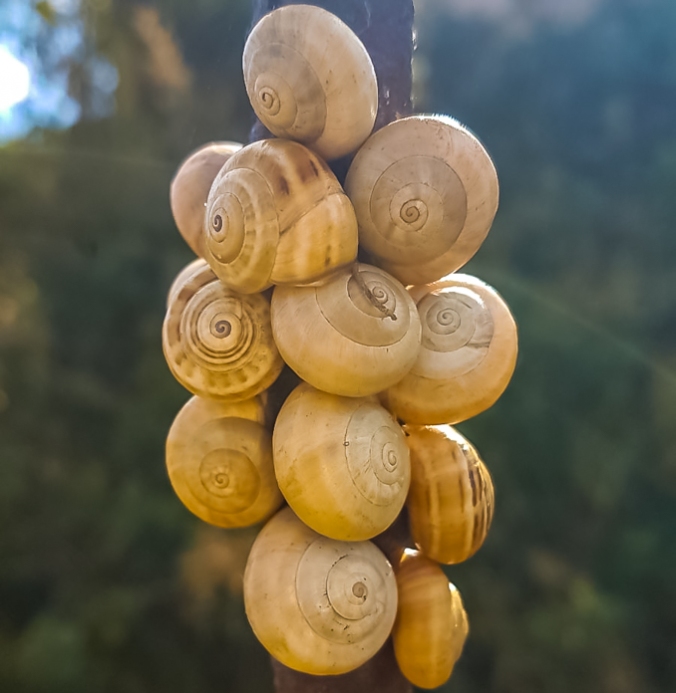
As we watch and observe, inevitably we come to realise that there are patterns, structures and schemes in everything Nature does and creates. There are rules and regulations that get repeated again and again. One might say that there is an underlying code, a secret canon perhaps of form, shape and conduct that governs the way things are shaped and the way things grow. The makeup of organisms and the structure of plants and animals all seem to follow a rule that perhaps is best explained by the shape of a spiral. A snail’s spiral pattern might be the pattern that illustrates best the way Nature organises herself.

The Italian mathematician Leonardo Pisano Bigollo, better known as Fibonacci (ca. 1175-1250) was perhaps the first to discover that secret canon (well, it should be mentioned that even before him, the sequence had been noted by Indian mathematicians as early as the 6th century). Fibonacci came to express it in a mathematical formula that is known as the Fibonacci sequence: 1, 1, 2, 3, 5, 8, 13, 21, 34, 55, 89, 144, 233, 377, 610, 987, ad infinitum.

Fibonacci 12

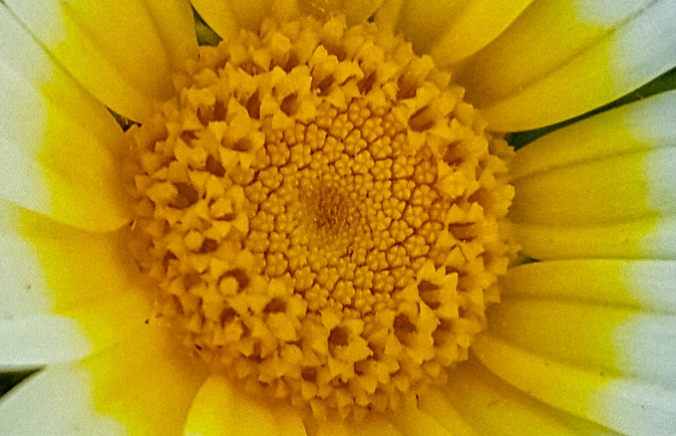
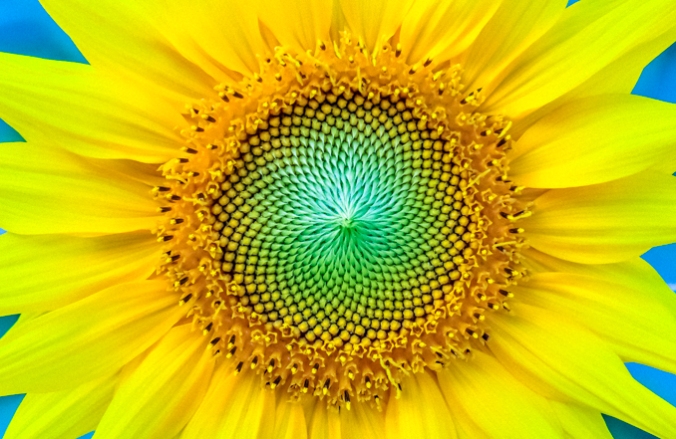
One might call the Fibonacci sequence Nature’s numbering system. It seems to appear everywhere in Nature, from the leaf arrangement in plants to the branch arrangement on trees, from the pattern of the florets of a flower to the bracts of a pinecone and the scales of a pineapple. The Fibonacci numbers seem applicable to the growth of every living thing, including a single cell, a grain of wheat, a hive of bees, and even man and woman and all of mankind. Even the Milky Way seems to be structured around the same shape or pattern, and other galaxies also follow the spiral Fibonacci pattern. This pattern or number sequence is often called Golden Ratio or the Golden Section.

Fibonacci 22

What has all that got to do with wine you may ask?

Well, if you make organic wine the way we do at Son Alegre there is no question that Nature has to be the guiding force. We cultivate our vineyard according to the principles of Masanobu Fukuoka (1913-2008) which implies a “total respect for Nature and the environment”. Our vineyard is a perfect example of how Nature looks after herself. We love our work and our vineyard; hence we are grateful to each stone, each branch, and each animal or insect, thanking them for their contribution and collaboration so that this land enables the vines to produce grapes and give us the best 100% organic wine possible. Only through respect and love of Nature can we find the balance and harmony that we have all lost and which we do need so urgently.

Fibonacci 18

The particular weather conditions of our land give our wine the unique and special qualities it has. During the hot months of summer, the cold air coming from the sea is reacting with the warmer air which has been heated by its contact with the warm earth and this encounter generates a fresh air stream during the hot afternoons. One tends to believe that it is the grape which gives the wine its flavour, when it really is the soil on which the grapes are cultivated creating our wine’s particular taste. This is due to the typology of the soil, Call Vermell in our case, providing some elementary nutrients to the vines, and also partly due to the microclimate of the area.

Fibonacci 17

At Son Alegre, a very important guide for our work is the lunar calendar. By observing the phases of the moon, the way our ancestors always have, we know the most propitious time for the pruning of our fruit, the grafting of plums on to almond branches, the planting of new trees, the sowing of cereals, the harvesting of our grapes, the mating of pigs, sheep or donkeys, or even the cutting of our hair. Nature creates and gives peace, supports us and helps us find a balanced state, just what is needed so badly in our times.

Fibonacci 16

We grow vines on 12 hectares at Son Alegre on the edge of Santanyí, in the area between Son Danus and Ses Angoixes. For us, growing the grapes is an opportunity to live out our fascination of the wonderful complexity of the natural environment. We use the classical methods of practice in viticulture and oenology. The grape harvest is done only by hand and in crates, the pressing is done the traditional way, the fermentation is facilitated with indigenous natural yeasts and the barrels used for the ageing of our red wine are made of French oak.

And all of this makes for a better wine. At least this is what we believe.

Fibonacci 15

We Are Proud To Introduce Pep Costa 2015, An Elegant White Wine

Giró Ros 1

The fruity mellow white wine of our 2017 season is dedicated to Josep Costa Ferrer, the founder of Cala d’Or. We applaud Pep Costa’s visionary perceptiveness and are happy to bear witness to him being named Hijo adoptivo de Santanyí (adopted son) later this year (August 11th, 2017). The photo below shows Josep Costa Ferrer and his wife Modesta Gispert Vilardebó in the year 1905.

Pep Costa 4

Our elegant new Pep Costa 2015 white wine is composed of organically grown Giró Ros grapes, an autochthonous Mallorcan variety. The grapevines were four years old when the grapes were selected by hand at the end of August 2015. Son Alegre is one of only a few vineyards of Mallorca cultivating all their vines according to EU organic farming standards following the principles of Biodynamic Agriculture. All our wines are rigorously controlled by the CBPAE (Consell Balear Regulador de l’Agricltura Ecològica – Balearic Council of Organic Agricultural Production).

Giró Ros 5

The mature white wine was vinified at a temperature of between 16 and 18º C during the fermentation process with a maceration of 21 days. The fermentation took place in temperature controlled stainless steel tanks. The wine matured for ten months in the tanks and a further ten months in the bottle. The wine was bottled in February 2017. The alcohol content is 11.8% Vol. Only 4,000 bottles were produced. We would like to have had more of this wine but we are a young and still small vineyard. In any case, we are grateful for what we have been able to achieve in the fifteen years of our existence.

Pep Costa 2

Pep Costa 2015 white wine is best served at a temperature of 8-10º C and is well suited to the hot days of the Mediterranean summer and the setting of our beautiful Isla de la Calma. The wine is agreeable on the palate, fresh and distinct. The colour is crisp and full. The wine has a complex disposition and can be drunk on its own, in the company of good friends, with appetisers, tapas or cheese, with fish or seafood, with chicken or white meat, with  pasta and also with vegetarian dishes. 

Giró Ros 2

At Son Alegre, we continue to cultivate all our grapes and all other crops with the utmost regard for Nature, respecting our land and our soil by following biodynamic principles according to Rudolf Steiner and adhering to some guidelines of Masanobu Fukuoka and Bruce Charles “Bill” Mollison, by applying methods of natural farming and permaculture to agriculture done the organic way. We simply allow Nature to fulfil its integrated and holistic function, although this may occasionally lead to reduced volumes and a lower profit margin. Profit-making is never our primary concern.

Quality is our principal objective.


Allow Us To Present Our New Sileo Extra Virgin Olive Oil

Sileo 1

Over the last fifteen years or so, there has been quite a renaissance of quality virgin olive oils here in Mallorca. It is really quite remarkable. In the Nineties, Mallorcan olive oils were few and far between. Now, however, we are spoilt for choice of Mallorcan virgin olive oil from Sóller, Caimari, Manacor and Santanyí, to name but a few of the main olive growing regions. The Consell Regulador de la Denominació d’Origen Oli de Mallorca applies strict measures of quality control and today endorses a sizeable number of olive oils with a Denominació d’Origen certificate.

Sileo 2

Currently, there are 69 Virgin Olive Oils labelled with the ‘d’O‘ seal, the Oli de Mallorca Denomination of Origin. This certificate was created in 2002 in accordance with European Union regulations, confirming that the thus marked and sealed oil is an agricultural product originating from a clearly defined location whose quality and characteristics are principally due to the geographical environment in which it is produced by natural factors and human activity.

Sileo 5.jpg

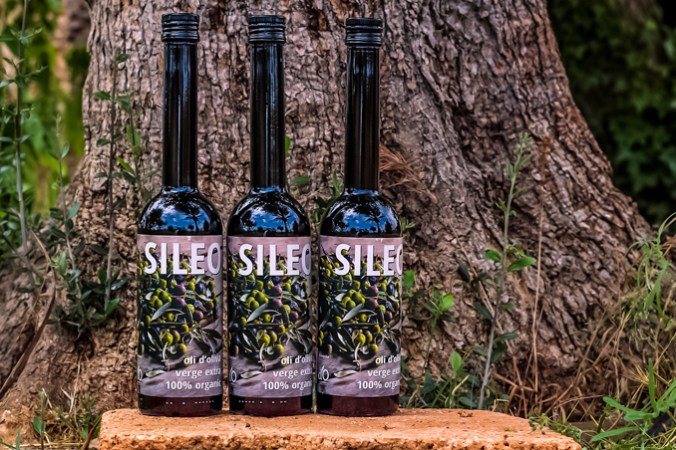
Of the 69 Mallorcan Virgin Olive Oils, only seven are grown and produced under 100 % organic conditions as controlled and certified by the CBPAE (Consell Balear de la Producció Agrària Ecològica), without the use of any pesticides, insecticides, chemical substances or inorganic fertilisers. Sileo oli d’oliva verge extra from Son Alegre is one of these few Mallorcan quality olive oils and it is 100 % organic. Try some if you can. You will like it.

Sileo 6

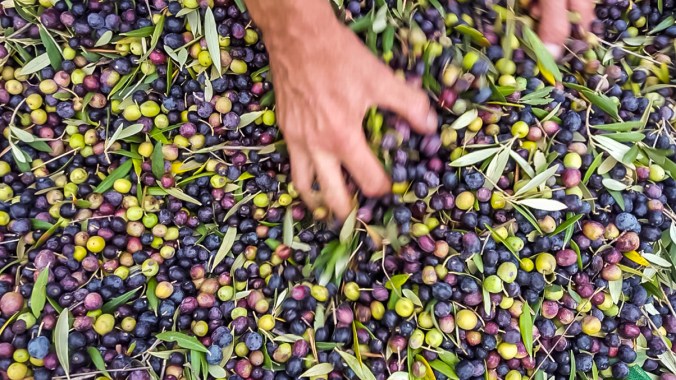
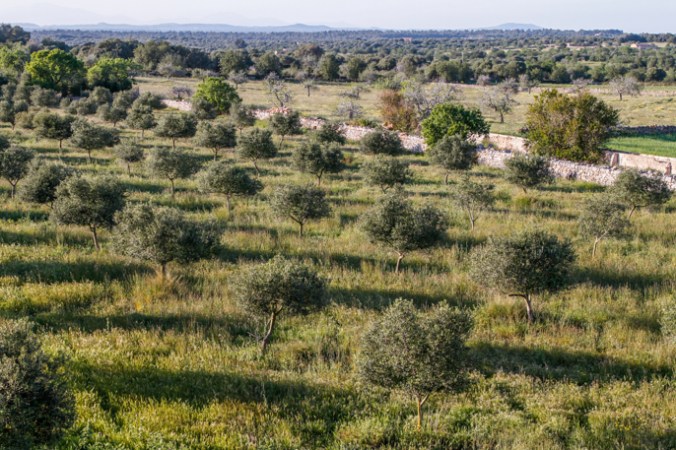
ArbequinaEmpeltre, Picual and Hojiblanca are the principal olive varieties on this island. Our olives are of the Arbequina variety. We harvest them by hand in late October when the olives on the tree are three different colours, green, purple and black. The three colours signify that not all of the olives are fully ripened – if they were, they would all be black. We have decided to let some olives not quite ripen. That way we can ensure a superior quality of olive oil combined with a better taste. If we were to wait any longer, chances would be that the olive fruit would be attacked by the Olive fruit fly (Bactrocera oleae), a serious pest in the cultivation of olives, and that would of course alter the taste of our oil dramatically, unless we were to spray against the little insect. We will never spray, and hardly ever with with copper, which we are allowed as an organic producer. We are committed to Nature and to the wondrous ecosystem on our land that we have allowed to develop over the last ten or fifteen years. We have not plowed our olive orchard once in the last twelve years; in fact we do not even enter our orchard all year long other than at harvest time, simply to leave the trees, their natural environment and our biological ecosystem as well as the prevailing biodiversity completely undisturbed.

Sileo 4

Every year, our olives are the first ones to be pressed at our Tafona (oil mill) in Sóller, the Cooperativa Agrícola de Sant Bartomeu de Sóller. The oil mill is famed for their gentle handling of olives and renowned for their output of oil of the best quality. We are proud to collaborate with them year after year and we are grateful for the liquid gold that they gently press hydraulically from our olives, store for us during the two or three months of the settling process and the bottling of Sileo Extra Virgin Olive Oil at the end of their labour. Before bottling, our olive oil is tested by an ENAC-laboratory (Entidad Nacional de Acreditación). Our 2016-17 Sileo virgin olive oil extra was measured with a degree of acidity of 0.6%.

Sileo 4

Here is a photo showing the production of olive oil in Mallorca in times gone by, courtesy of Oli Monnàber Vell in Campanet (photographer unknown).  Muchas gracias.

All photos of today’s entry were taken, as always, by John Hinde, with the exception of the historic photo (above). Thank you, John.

The Old Wine Cooperative of Felanitx


Es Sindicat Felanitx 3

An amazing building can be found on the outskirts of Felanitx in the Southeast of Mallorca, a massive piece of architecture in a post-Modernismo style, the Bodega Cooperativa, locally known as Celler Cooperatiu Es Sindicat. This large-scale winery was built in 1921-22 by Guillem Forteza when Felanitx happened to be a major centre of wine making. The business was run until 1991 when the cooperative set-up  ran out of steam and was forced to terminate its activities.

Es Sindicat Felanitx 2

The building was classified by the Consell de Mallorca in 2001 as a BIC (Bien de Interés Cultural), a type of heritage monument. Sadly, some of the glamour of the building has been spoilt by vandalism and defaced by graffiti.

One can assume that one is not allowed to enter the building. It is all boarded up even though some entrance points are left open due to carelessness or neglect. There are obvious dangers and safety risks. The erstwhile bodega has not been used for wine making for well over twenty-five years and consequently, its installations are run-down, ramshackle, decrepit and in parts, simply ruinous. By the same token, the place is fascinating for its sheer size, its magnitude in ambition, the visual beauty of some of its details and the massive dimension in storage facilities for hectolitres upon hectolitres of wine. The massive silo tanks were built on-site in concrete and must have held some 10,000 litres each, or even more. There are about 130 of these tanks, allowing for a total of perhaps 1,500,000 litres of wine being macerated and consequently subjected to the fermentation process, all at the same time. Plus, there are a dozen or two cistern-like storage tanks, holding up to 30,000 litres each, plus four massively big cylindrical storage steel tanks outside holding perhaps 100,000 litres, or even more, each. They must have drunk a lot of wine in the old days, here on the island. There is no bodega of this enormity in present day Mallorca.

Es Sindicat Felanitx 4

An interesting website on the Internet is run by a circle of friends of the old Sindicat building, should you want to know more and in greater detail. From that website, we have borrowed a video dating from 1929 documenting the construction of the building, the wine making process and the transportation of the Bocoyes (wooden wine barrels of 640 litres capacity) by train:

https://youtu.be/pOcGrlmzFcg

Our very own oenologist, Luis Armero Gonzáles, worked at Es Sindicat as Head of Operations from 1982 to 1986 before setting up his own bodega in Felanitx, Armero i Adrover. During Luis’s time the Felanitx wine cooperative produced some staggering 1,800,000 litres of wine per annum, mostly Rosé but also some 25 % of red and perhaps 15 % of white wine.

Luis Armero Gonzáles

The Felanitx town hall has been trying to acquire the Sindicat building for a number of years now with the idea of converting it into a place of cultural and historical interest, possibly with the help of Felanitx-born artist Miquel Barceló. These plans have not come to fruition as yet and currently an application is being considered to dispossess the current owners on the grounds of negligence and for causing a safety and health hazard to the public.

Es Sindicat Felanitx 5


We Are Proud To Announce The Launch Of Our New Organic White Wine, Ramon Lo Foll 2016

Vineyard Son Alegre is happy to present this year’s white wine, Ramon Lo Foll 2016.

Son Alegre Ramon Lo Foll 2

The new white wine of our 2017 season is dedicated to Ramon Llull, the Mallorcan writer, philosopher, teacher and mystic of the 13th century whose 700th anniversary of death was celebrated last year. He called himself, jokingly, Ramon Lo Foll (Ramon the Fool). We admire Ramon Llull and his way of contemplating the world. He was one of the greatest thinkers that Mallorca has ever seen and we are glad to pay homage to this outstanding man.

Son Alegre white wine 2

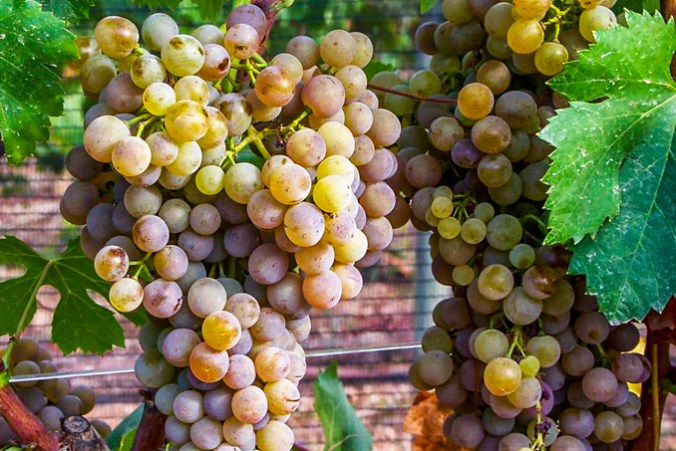
Our new Ramon Lo Foll white wine is a composition of organically grown Chardonnay, Giró Ros and Malvasía grapes in equal parts. Our vines were eleven years old at the time of the harvest. All grapes were carefully collected by hand, at the end of August 2016. Vineyard Son Alegre is one of the few vineyards of Mallorca cultivating all their vines and in fact all their land according to EU organic farming standards following the principles of Biodynamic and sustainable agriculture. We take the natural harmony of Nature serious. We are farming in sustainable ways based on an understanding of the ecosystem and the study of relationships between organisms and their environment. As a consequence, we leave our soil undisturbed by not ploughing our land.

Son Alegre white grapes 1

Our new young white wine was vinified at a controlled temperature of between 16 and 18º C during the fermentation process with a maceration of 20 days. The fermentation took place in stainless steel tanks. The wine matured for six months in the tanks and a further two months in the bottle. The wine was bottled in March 2016. The alcohol content is 12.5% vol. Only 8,000 bottles were produced. Ideally, we would like to have had more of this wine for sale but we are only a small vineyard. Quantity is not our main objective; quality is, as well as an utmost respect for our land with the highest regard for Nature and the environment. In any case, we are grateful for and appreciative of what we have been able to achieve at Son Alegre over the last few years since we started our vineyard.

Son Alegre Ramon Lo Foll 1

The Ramon Lo Foll 2016 white wine is best served at a temperature of 8º C and is well suited to the setting of Mallorca and to the Mediterranean climate. The wine is pleasing on the palate, fresh and refreshing. Its colour is clear and gentle. The wine has a distinct character and can be drunk on its own, in the company of good friends, with snacks or cheese, with fresh fish or with chicken, white meat, pasta or vegetarian dishes. Enjoy. And please, drink in moderation.

Son Alegre white grapes 3

Salut.

The Amazingly Rich Diversity of Balearic Grapes

die-balearen-1

Between 1869 and 1891, the Archduke Ludwig Salvator of Austria published the most intriguing œuvre about the Balearic Islands under the title Die Balearen, spanning some 6,000 pages of information spread over 9 books. Ludwig Salvator, for nearly 40 years a resident of Mallorca, learned the island’s local language and conducted research into its flora and fauna, history and culture, as well as agriculture, architecture, industry and navigation, and so forth.

die-balearen-2

The extraordinary publication is pretty rare in its original edition, published in German, but book lovers can sneak a glimpse of the beautiful edition by visiting the impressive library at the Fundación Bartolomé March, in Palau March, just below the Palau de l’Almudaina in Palma. Admission is free (Monday, Wednesday and Friday from 9:30 to 14:00h, Tuesday and Thursday from 16:00 to 20:00h). Or you could have a look at the online version here (in German).

It would appear that the Archduke’s masterpiece, which has no equal in the field of regional studies and ethnology, was never published in English, however, it is available in Spanish (Caixa d’Estalvis de les Balears “Sa Nostra”, 1980-91) and, as far as the Mallorca segment is concerned, also in Catalan (Govern de les Illes Balears and Grup Serra, 1999).

In an ample chapter on agriculture the encyclopaedic publication contains in all three languages a prolific section on vines and winemaking, with the description of 39 indigenous grape varieties found in Mallorca, Menorca and Ibiza. The Archduke is said to have planted the Malvasia grape on his estate near Valldemossa.

malvasia_

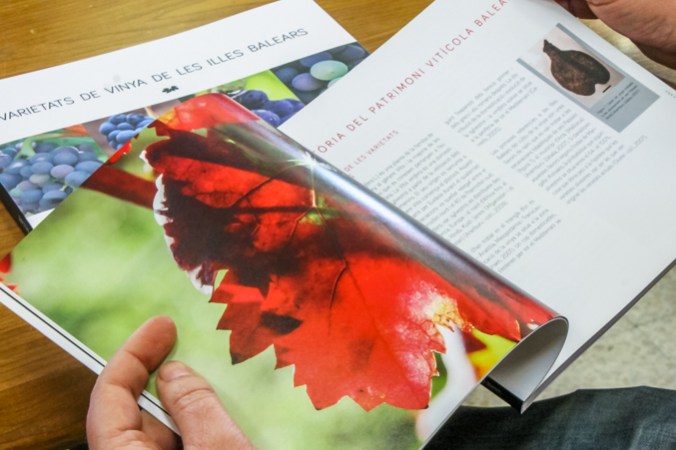
Only last week, the Govern de les Illes Balears and its Department for Environment, Agriculture and Fishery published a very useful and informative book in Catalan about the native grape varieties in the Balearic Isles. If you are interested in wine and wine making in Mallorca, give yourself a treat and acquire this stupendous sourcebook, listing, in great detail, 28 autochthonous grape varieties suitable for winemaking (Al·leluia, Argamuss, Batista, Batista mallorquin, Callet, Callet negrella, Escursac, Esperó de gall, Fernandella, Fogoneu, Fogoneu mallorquí, Gafarró, Galmeter, Giró negre, Giró ros, Gorgollassa, Malvasia de Banyalbufar, Mancès de capdell, Mancès de tibús, Manto negro, Moll, Quigat, Sabater, Sinsó, Valent blanc, Valent negre, Vinater blanc and Vinater negre) plus 10 more varieties classified as table grapes (Calop blanc, Calop negre, Calop vermell, Joanillo, Mamella de vaca, Moscatell, Moscatell romà, Pepita de oro, Pepita rosada, Peu de rata).

varietats-de-vinya_

Of course, many more grape varieties exist in Mallorca and are cultivated for winemaking but those are predominantly of either French, Italian, Spanish or German origin.

varietats-vinya_

To make things a little more complicated and perhaps also a bit more intriguing, there are some grape varieties that currently are not authorised for winemaking by the Mallorcan mandarins, be those grapes of foreign, national or native origin.

varietats-de-vinya-2

Oh well, politics.

varietats-vinya-3

Today’s photos of grapes and vineyard were taken by John Hinde. Thank you very much.

In February the almond trees are blossoming

son-alegre-ametllers-3

At Vineyard Son Alegre, we are not only interested in wine and olive oil. We are interested in all things of nature and everything else that makes and shapes the culture of our beautiful island.

The month of February is the time of the almond blossom. As our Mallorcan proverb says, ‘Pel mes de febrer floreix l’ametller‘ (in February the almonds are blossoming).

Right now almond trees are in full bloom all over the island. The Mediterranean climate aids the Almond tree (Prunus dulcis) even though it is not an indigenous plant like the Olive tree (Olea europaea), the Holm oak (Quercus ilex) or the Carob tree (Ceratonia siliqua). Almond trees were mostly planted here in the aftermath of the Philoxera disaster some hundred and twenty years ago which wiped out most of the Mallorcan grape plantation, to give affected farmers a new life-line and a new source of income.

son-alegre-ametllers-2

After the recent cold spell with the snow and heavy weather we had a fortnight or so ago, the flowering of the almond trees under a blue sky in February suggests the imminent arrival of Springtime and once again the awakening of the natural beauty of this island.

son-alegre-ametllers-4

Sadly, almond trees in Mallorca are currently suffering from a deadly disease or tree pest, an infection inflicted by the xilófago insect. Quite a number of almond trees have already died as a result of this affliction. One speaks of up to 12,000 hectares of almond plantations lost over the last few years. There is also recent news about the Xylella fastidiosa bacterium, a vibrant plant pathogen that causes further damage to our almond trees as well as olive trees and cherry trees. Authorities in Spain are concerned that this bacterium also threatens citrus fruit trees as well as the Mallorcan vine.

son-alegre-ametllers-6

The town of Son Servera is holding the Fira de la Flor d’Ametler tomorrow from 09h00 to 14h30 in case you should be so inclined. We might as well enjoy this natural beauty whilst it is still around.

son-alegre-ametllers-5

All photos of today’s blog entry were taken by John Hinde. Thank you very much for letting us use them here.

The Soil Has the Last Word

conciencia-4

Son Alegre‘s Miquel Manresa was recently asked to give an interview by the new magazine ConCiencia, published in Palma on a monthly basis and now only in its second month. The interview was published in the issue of December 2016 under the heading ‘La tierra tiene la última palabra‘ (The soil has the last word). We at Son Alegre are very happy about this published feature and would like to give you the opportunity to see and read it for yourself.

conciencia-3

For those of our friends who might struggle a bit with the Spanish language, here is a brief translation of the interview:

THE EARTH HAS THE LAST WORD

Vineyard Son Alegre

The owner of Son Alegre, Miquel Manresa, proudly shows us his vineyard, a perfect example of how Nature looks after herself.

Our walk begins by listening to the “sound of the earth”. This man is in love with his work and his vineyard; he lets us participate in his dialogue. He speaks with each stone, with each branch, and each animal or insect, thanking them for their contribution and collaboration so that this land enables the fruit produce to give us the best 100% ecological wine.

The land is doing the cultivating process all on its own. There is no need for us humans to do what roots, worms and microorganisms can do best. In addition, the act of ploughing the soil alters the natural environment and promotes the growth of weeds. Miquel tells us with absolute conviction that only through respect and love of Nature we can find the balance and harmony we have lost and which we do need so much.

Miquel continues to tell us that the vineyard is cultivated according to the principles of Fukuoka [1] which implies a “total respect for Nature and the environment”.

The particular weather conditions of our land give our wine the unique and special qualities it has. The cold air coming from the sea is reacting with the warmer air which has been heated by its contact with the warm earth and this encounter generates a fresh air stream during the hot summer afternoons.

We tend to believe that it is the grape which gives the wine its flavour, when it really is the land on which the grapes are cultivated which creates its particular taste. This is due to the typology of the soil, providing some elementary nutrients to the vines and also partly due to the microclimate of the area.

At Son Alegre we grow vines on 15 hectares at two different locations, one on the edge of Santanyí, in the area between Son Danus and Ses Angoixes, and the other one in the neighbouring area of Can Taconer in Calonge.

For us, growing the grapes is an opportunity to live out our fascination for the wonderful complexity of the natural environment. We use the classical methods of practice in viticulture and oenology. The grape harvest is done only by hand and in crates, the pressing is done the traditional way, the fermentations are facilitated with indigenous natural yeasts and the barrels used for the ageing of the wine are made of French oak.

At Son Alegre, a very important tool for our work is the lunar calendar. By observing the phases of the moon, the way our ancestors always have done it, we know the most propitious time for the pruning of our fruit, the grafting of plum on to almond branches, the planting of new trees, the planting of cereals, the harvesting of our grapes, the mating of pigs, sheep or horses, or even the cutting of our hair.

He speaks very animatedly, explaining all the intricacies of the finca, that we find it slightly difficult to follow and, more so, transcribe so much information in a single interview.

Nature creates and gives peace, supports us and helps us to find a balanced state of equilibrium, just what is needed so badly in our times. Here, the conversation focuses on education and the importance of keeping children in permanent contact with a natural and healthy environment. *

* ConCiencia and MundoFeliz propose to our readers to use this special set-up to hold workshops for schoolchildren, to give the young ones an opportunity to connect with the land.

We could spend hours and hours talking to a person who conveys so much ancestral wisdom, learned through the work which he carries out day by day in his vineyard, being continually connected with Nature which he loves and so deeply respects.

Miquel, it would be an honour for us to have you at some of our conferences and events. You will always have a special space in our magazine. And of course, we will taste your wines!

To which he responds, with his usual relaxedness, being as calm and cheerful as is his land, that he will gladly share his knowledge with us, our readers and friends.

See you soon, Miquel.

conciencia-2

[1] The Principles of Fukuoka:

Do not plough or turn the soil: In this way the structure and composition of the soil is maintained with its optimal conditions of humidity and micronutrients.

Do not use chemical fertilizers or prepared compost: Through the interaction of the different botanical, animalistic and mineral elements of the soil, the fertility of the cultivated soil is regenerated as in any non-domesticated ecosystem.

Do not use herbicides or weed killers: These destroy the nutrients and microorganisms of the soil, and are only justified in monocultures. Instead, Fukuoka proposes an interaction of plants to enrich and control the biodiversity of the soil.

Do not use chemical pesticides: These also kill the natural richness of the soil. The presence of insects in farming can be healthy.

Do not prune: Allow the plant growth to follow its natural course.

Use clay seed balls.

These fundamental working principles are based on a philosophy of Do- Nothing (Wu Wei), or more accurately, of not intervening or forcing things.

Fukuoka reached a degree of comprehension of the microsystems of the soil and devised a system of farming that desists from unnecessary tillage and unnecessary endeavours of traditional agriculture. His method, which he sometimes called Natural Agriculture Mahāyāna, is based on starting to give and to then receive in a natural way, rather than be demanding on the soil until it is exhausted.

Winter in a Mallorcan Vineyard

son-alegre-dormition-5

When driving through certain parts of Mallorca in November and December, one will pass by many a vineyard in a state of colourful display – yellows, oranges and reds. These vineyards were full of activity during the months of August and September when the grape harvest was taking place. Now at the beginning of winter, the vine fields appear quiet and sturdy, tranquil, and often quite dead and without any active life whatsoever.

son-alegre-dormition-4

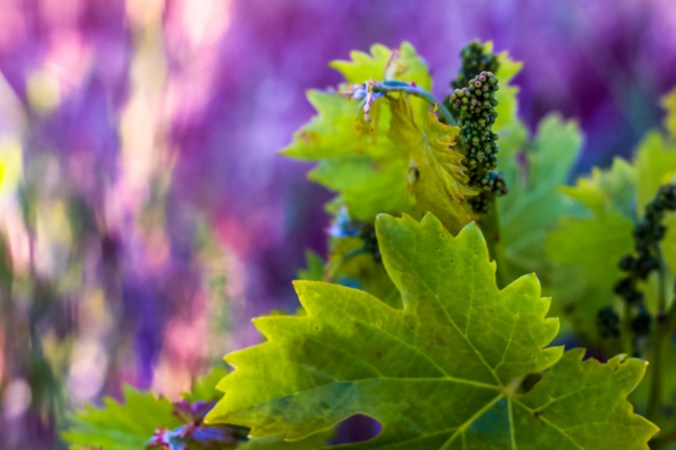
But invisible to us, there is more activity than meets our eyes. Yes, the Vitis vinifera vine plant has slowed down its business of fruit production but now it is producing a substantial amount of Ethylene (H2C=CH2), an organic compound which is needed for the process of abscission (the shedding of its leaves). At the same time, the vine plant is also producing Abscisic acid (ABA), a plant hormone which is needed to enter into the dormant state – the period of hibernation – during the winter months. ABA prevents cells from dividing and suspends growth.

son-alegre-dormition-3

The vine plant is very intelligent in as much as it knows exactly how to regulate its metabolism, its energy consumption and its growth. By stalling growth during the winter a lot of energy is saved. This process is similar to an animal’s hibernation. Most animals who hibernate store food as fat and then use it to run their essential systems during the winter, rather than grow any more. Likewise, the vine’s metabolism slows down during dormancy, and this is partly why cell growth is impeded. Since the plant has to conserve the energy it has stored, it is best if it uses the energy up slowly and only for essential functions.

son-alegre-dormition-2

We at Son Alegre think it is best not to interfere in this energetic process of shedding and absorption. In fact, we interfere in our vineyard as little as possible throughout the year. We have our unsung hero helpers such as ants and worms, ladybirds and bees, spiders and snails, who help us day in, day out, with the aeration of our soil and the distribution of plant nutrition, macronutrients, micronutrients and moisture. Without these helpers we simply couldn’t do our business; without them there would be no Son Alegre wine.

son-alegre-three-wines_

Let’s not forget what Nature does, every second of the day, all year round. Thank you.

And let’s not forget to say Thank you to John Hinde, the photographer of the photos of today’s blog entry and, in fact, of most of the photos published on this blog throughout the year.

Thank you, John. Thank you Nature. Muchas gracias.